 PURSUED BY A BEAR
Executive Reporting for Arts and Nonprofits
Bring cash, ticket sales, fundraising, forecasts, and staff context into an executive briefing that supports decisions.
Pursued by a Bear helps arts and nonprofit leaders bring information together for executive reporting. The starting point is the management question: what do you need to understand, what information supports an answer, and who needs to review it?
Apollo 11 Mission Control · July 20, 1969 · Photograph: NASA
Where this work began
The executive dashboard grew from work with a major regional nonprofit theatre. Understanding the organization’s position meant looking across accounting, ticketing, fundraising, spreadsheets, and staff correspondence.
An email about a payment or commitment could explain something the numbers alone did not. Bringing those explanations into the same view as the financial and operational information was part of the management task.
The case at a glance
- Originating project
- An executive dashboard developed for a major regional nonprofit theatre, described here anonymously.
- Information involved
- Financial reports, bank balances, ticket and subscription reports, fundraising reports, cash forecasts, restricted funds, treasury emails, and staff updates.
- Executive view
- Available cash, sales activity, fundraising progress, and issues requiring attention.
- Interpretation
- Commitments affecting cash, a distinction between reported actuals and projections, and visible dates and assumptions.
- AI’s role
- AI assisted development of the dashboard.
- Public demonstration
- Fictional figures, organizations, and source updates. The interface does not demonstrate live AI analysis.
What a useful report needs to explain
A report should help a leader understand what has changed, what needs attention, and which questions remain open. Depending on the organization, that might include:
- The current cash position and upcoming pressures.
- Ticketing performance against an agreed comparison.
- Fundraising activity and its relationship to expectations.
- The assumptions behind a forecast.
- Staff explanations that help interpret a change.
The selection should follow the decisions you need to make. A clear explanation of a missing input or an uncertain forecast may matter as much as another measure.
Keep the sources and assumptions clear
For your reporting process, we would agree on which sources to use, who owns them, and the reporting date and period. We would distinguish recorded activity from forecasts and staff interpretation.
A fundraising commitment and cash received are different events. A ticket-sales comparison needs a consistent basis. An email may provide valuable context while requiring confirmation from the appropriate colleague.
Material claims need a basis that a reviewer can inspect. Missing or conflicting information needs to be identified. Human review remains part of the work, with responsibilities agreed on before the report is used for important decisions.
Start with one recurring report
A possible engagement could begin with an executive briefing, a management report, or part of a board reporting process. We would define a first useful version around a specific decision and the available information.
The scope could include:
- Reviewing the current report, its audience, and the preparation work.
- Agreeing on inputs, definitions, permissions, and review responsibilities.
- Developing a first version and checking it against the agreed sources.
- Reviewing its usefulness with the staff who prepare and use it.
- Documenting the process, training the people responsible, and agreeing on ongoing support.
Some projects may work from existing exports and spreadsheets. Others may need an integration. That choice belongs in the scope, together with an assessment of where AI would be useful.
Explore the fictional demonstration
The public executive dashboard illustrates the reporting format with fictional figures, organizations, and source updates. It does not demonstrate live AI analysis.
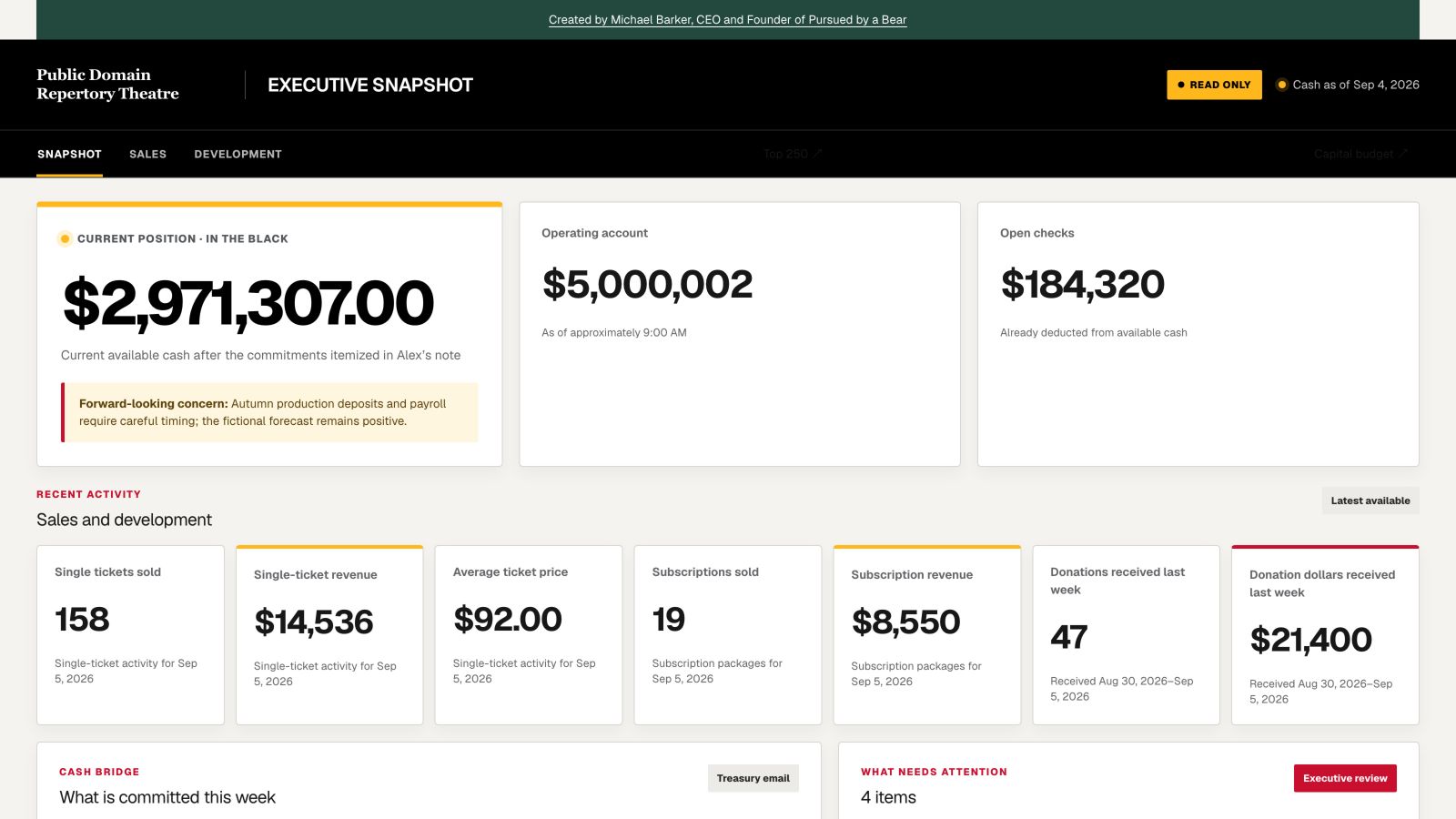
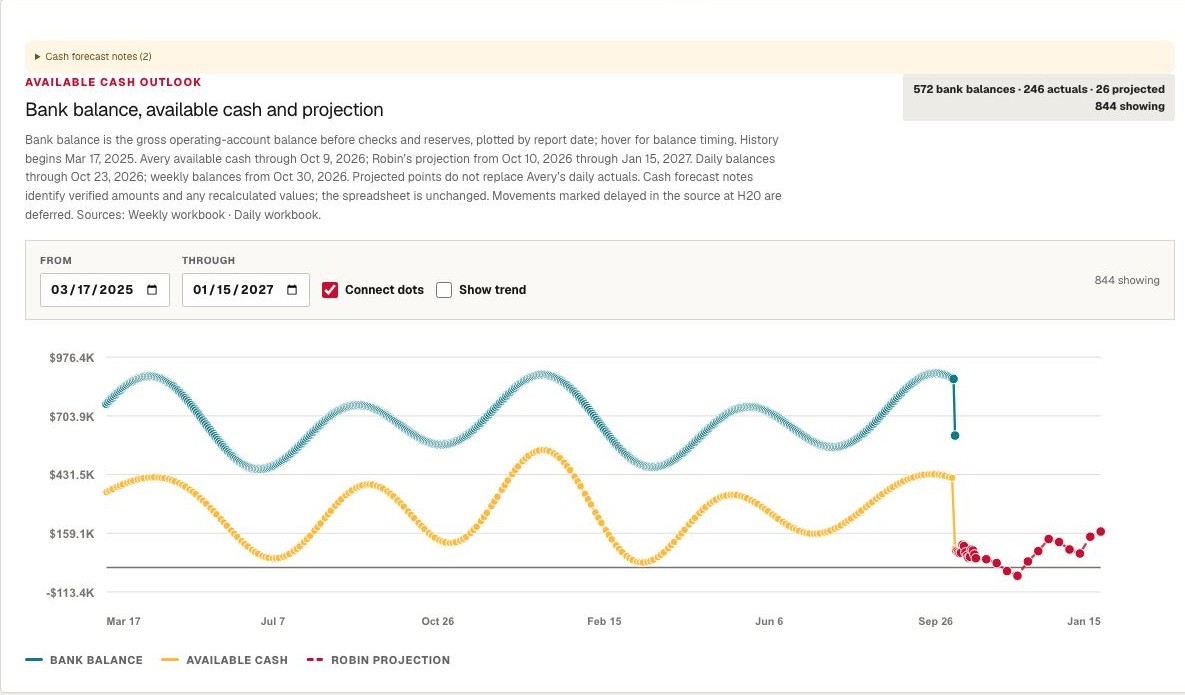
Use it to consider what would be helpful in your own reporting: the questions to answer, the information to bring together, and the level of detail your leadership team needs.
Questions about an engagement
Is this relevant to our organization?
This work is intended for arts and nonprofit teams interpreting information spread across reports, spreadsheets, systems, and staff correspondence. A conversation can establish whether your immediate need is a clearer report, a better preparation process, an integration, or a combination.
Who would lead the work?
Michael Barker brings more than 20 years of nonprofit leadership experience, including managing-director roles at Westport Country Playhouse and Marin Theatre Company. He leads Pursued by a Bear. Read Michael’s background.
A proposal should identify responsibility for development, staff participation, review, and handover.
What would it cost?
Cost depends on the report, the number and condition of its sources, update frequency, integrations, training, and support. Those details need to be established before quoting a fee. A proposal should distinguish project fees from recurring software, usage, or maintenance charges.
How would we know whether a pilot worked?
Agree on the criteria before development begins. They might include reconciling selected totals, tracing material claims to sources, handling missing information clearly, and enabling a staff member to operate the process using its documentation. If reducing preparation time is a goal, measure the existing workload and include review and correction time in the comparison.
Discuss your reporting needs
Bring an example of the report you prepare, the questions it needs to answer, and a description of its information sources. We can use that to discuss a manageable starting point and what a proposal would need to cover.