 PURSUED BY A BEAR
Fundraising Prospect Research and Donor Workspaces
Give your development team a clearer view of the people behind the records. Pursued by a Bear brings giving history, ticketing, biographies, relationships, research sources, and staff activity into a workspace built around the questions your team needs to answer.
The work begins with the information you have, the decisions you need to make, and the people who will use the results.
The public demo uses 250 fictional people and simulated records. Use fictional information when trying its notes and workspace features.
Under the Wave off Kanagawa (detail) · Katsushika Hokusai · The Metropolitan Museum of Art
From scattered information to a usable workspace
The original project involved more than 3,000 prospects. The separate public demo uses 250 fictional profiles. The challenge was bringing information together so a development team could review a person, understand the evidence, and decide what needed attention.
A constituent record tells part of the story. Giving and ticketing histories add context. Biographies, research sources, relationships, and staff activity add more. A useful workspace lets people move among those records while keeping track of where the information came from.
That is the approach illustrated here: organize the evidence, make it easier to inspect, and give staff a practical place to continue their work.
Explore the public demonstration
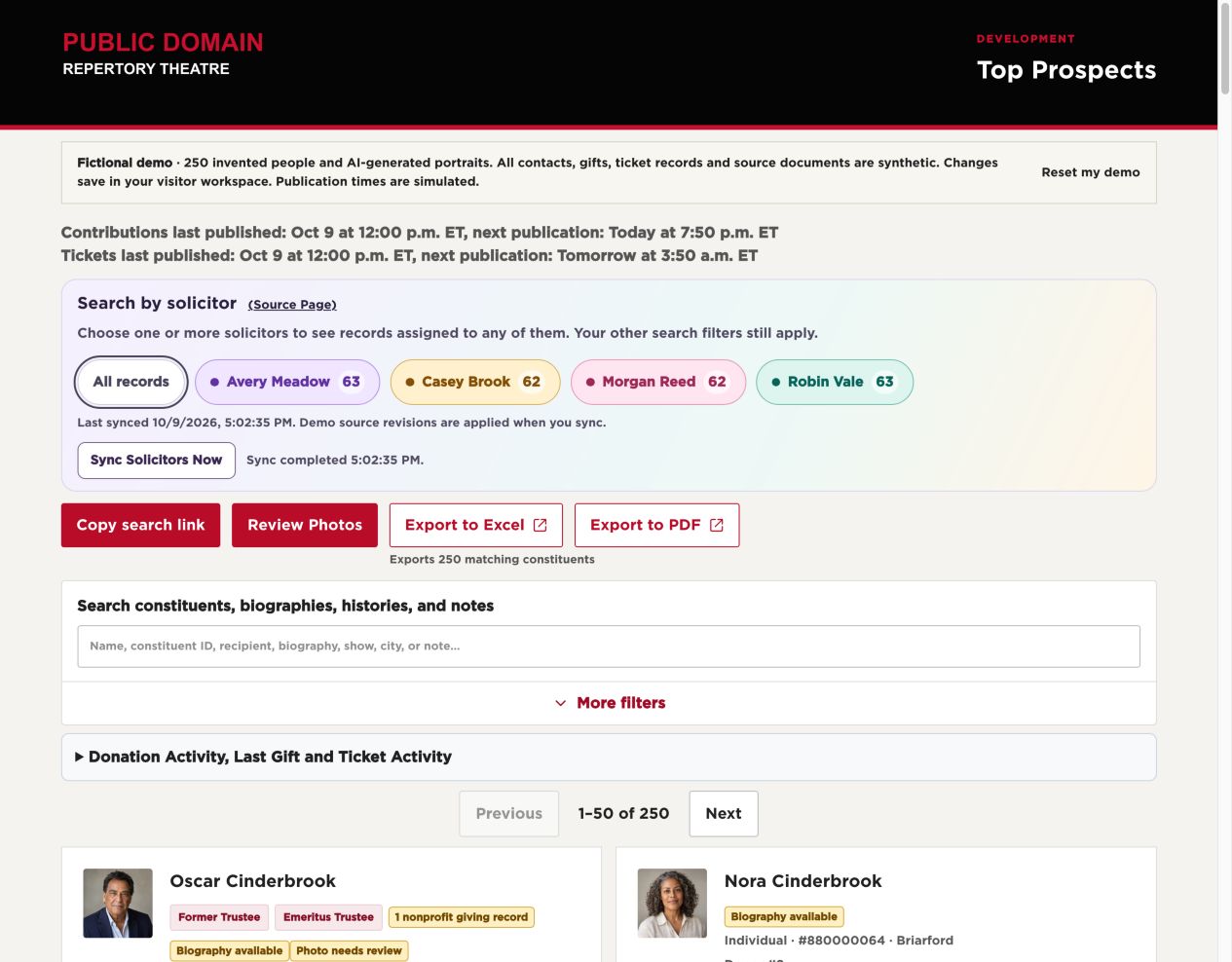
The demo contains 250 fictional people. Contact details, gifts, ticket histories, research material, and displayed publication times are simulated; portraits are AI-created. These are invented demonstration records, not anonymized donor files. The demo includes visitor-workspace controls; use fictional information only.
You can explore several parts of the workflow:
- Find a useful group. Search and filter the list, including solicitor and activity views, to focus your review.
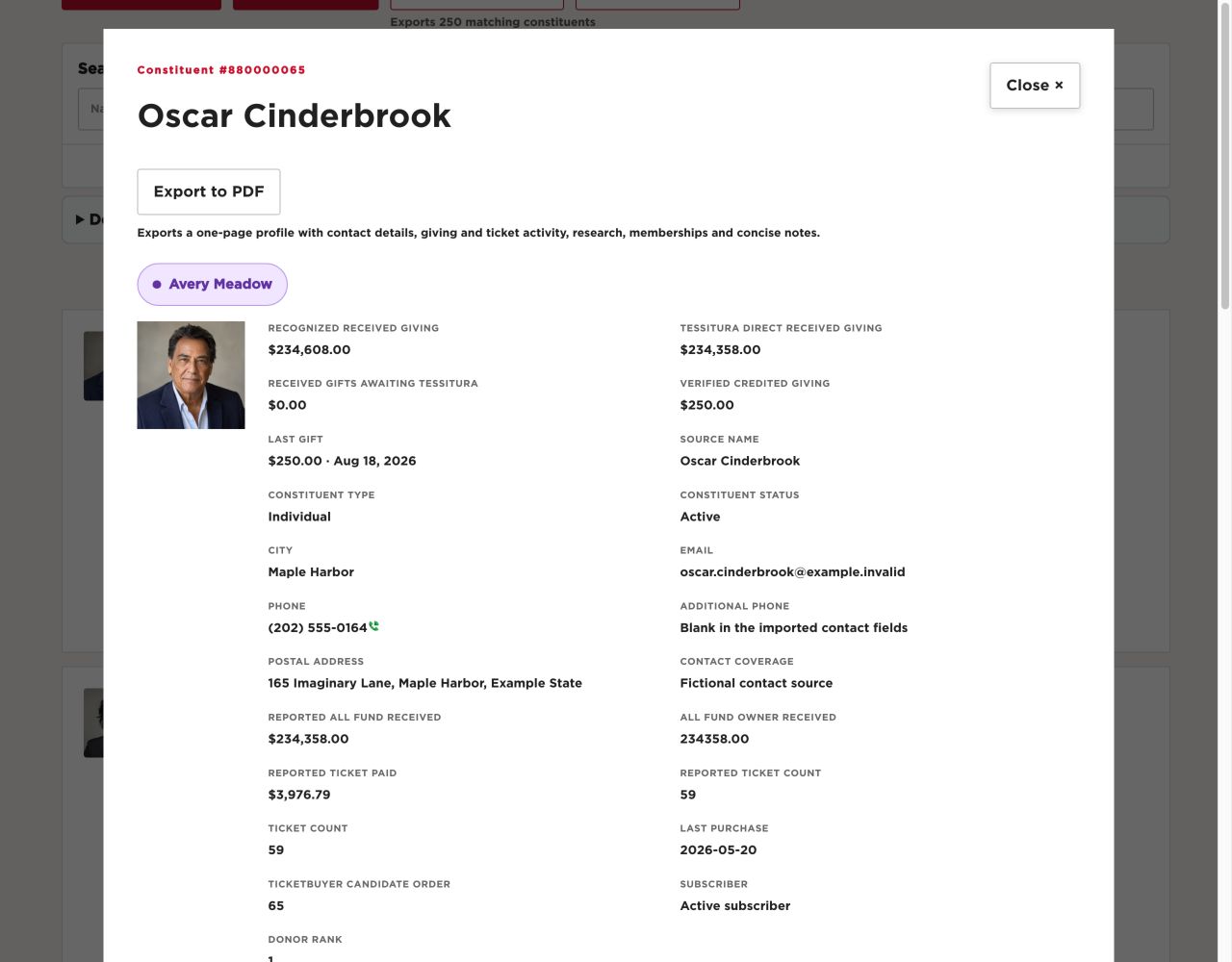
- Review a person in context. Open a profile and move through giving, attendance, biography, relationship, and source information.
- Check the evidence. Examine how source records and giving categories are presented before drawing a conclusion.
- Continue the work. Review the controls for notes, photo review, and record-status flags, using fictional information only.
- Prepare a working view. Use the Excel and PDF exports to inspect how a filtered view can travel into another part of the team's work.
Start with a filter, open one record, and review its sources. That sequence shows more about the tool than a screenshot alone.
Keep different kinds of giving distinct
A received gift, a recognition credit, and a research finding mean different things.
Direct received gifts record gifts received by the organization. Verified giving credits document an attribution or recognition associated with a gift; they do not create an additional receipt. Unverified amounts remain research items to check. Outside giving concerns gifts to other organizations and stays separate from your organization's receipts.
Those distinctions matter when the same gift appears in several records. A profile should help staff follow the evidence without counting one gift several times or treating an uncertain amount as established fact.
Source review also helps staff identify incomplete information, mistaken matches, and questions that need a conversation with someone who knows the relationship.
Where AI fits
AI helped develop the tool and create the fictional demonstration materials. Research conclusions still require source checks and staff judgment.
A biography or portrait cannot establish someone's giving capacity. Attendance records can show a connection to an organization, but staff must judge what that connection means. The purpose of the workspace is to make relevant information and its sources easier to review.
Build around your team's work
A comparable engagement starts with a defined set of records and a specific staff task. We agree on which sources can be used, what needs to be verified, who will review the results, and how the workspace should fit your existing systems.
The scope should also settle who may edit or export information, what documentation and training are needed, and who will maintain the work afterward. You can explore related possibilities in Services and the broader method in Our Approach.
Questions before we begin
Is this suitable for an arts or cultural nonprofit?
Yes. The combination of giving, attendance, relationships, and staff activity is relevant to development teams in arts and cultural organizations. The starting point is your team's actual work. Explore the services.
Who would we be working with?
Michael Barker has more than 20 years' experience leading mission-driven institutions, with an MFA in theater management and an MBA from Yale. His professional biography describes the management and fundraising experience behind this work.
Can this fit our existing systems?
That is a scoping question. We examine your records, access, and workflow before proposing a workspace or integration. Read how we work.
What would an engagement cost?
Cost depends on the sources, record volume, research depth, implementation, and support required. A written scope should identify those elements and the fee before work begins. Read about project pricing.
How should we evaluate the work?
Try the public demo, follow a record's sources, and test the actions that matter to your team. Ask about comparable work and how review and handoff would operate. Read Our Approach.
What should a first project prove?
Agree on a bounded record set and a staff task. Test whether people can find the information they need, trace it to its sources, correct problems, and use the result in their work. Plan the first project around that test.
Discuss your fundraising workflow
Bring a question about the work your team needs to do. We can start by discussing the records and decisions involved, without sending donor data through this website.